BOOKS
Lost Cathedral | Cornerstone Press
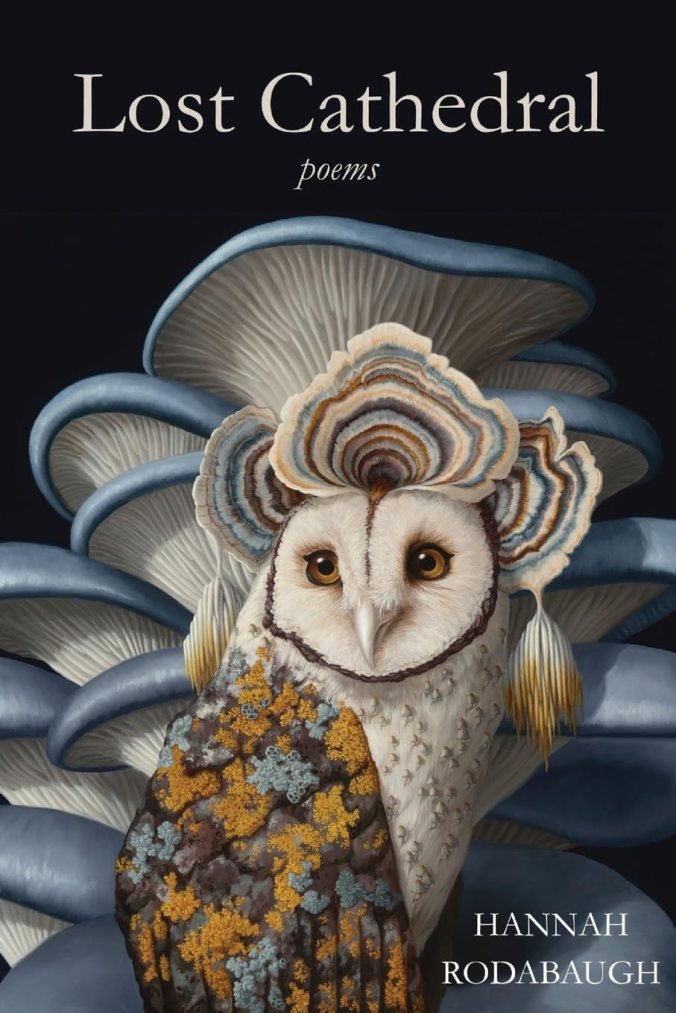
What do we lose when ecosystems are degraded through human use and misuse? How do we process the damage, both environmentally and culturally? How should we feel about individuals who unknowingly participated in extinction events? How should we feel about the ways that we may be equally culpable? In her stunning study of the American wilderness and the emotional aspects of extinction, Hannah Rodabaugh crafts a moving elegy to what we’ve lost, and where we go from here.
- Cornerstone Press
- Amazon
- Bookshop
- eBay
- Books-A-Million
- Walmart
- Barnes & Noble
- Sons & Daughters Books (Small Business)
CHAPBOOKS
The Leonids | Bottlecap Press

The Leonids reflects on the impacts of the COVID-19 pandemic, touching on everything from Long COVID to the trauma of losing loved ones to the claustrophobia of sheltering in place. Its short, fragmentary poems weave together snapshots of the author’s personal experiences with the larger state of the world, asking readers to grapple with the ways they may be culpable for how the social contract of collective empathy and care disintegrated during the pandemic.
The title was borrowed from the Leonid meteor shower, which appeared annually in the years preceding the pandemic, and from the mistaken belief that similar celestial events could foretell epidemics. Poems from the collection are part of Boise’s permanent historical archive on life during the pandemic.
We Don’t Bury Our Dead When Our Dead Are Animals | Another New Calligraphy

Unparalleled in the geologic record, Earth’s premier superpredator has thrived in every habitat imaginable and wrought deadly havoc upon the flora and fauna in its path. Incomparable predation coupled with rampant environmental degradation has proven to be an effective skillset. In its wanton disregard of ecology, Homo sapiens has triggered the planet’s sixth mass extinction event, with estimates of species loss ranging from one hundred to ten thousand times the norm. Still, biologists suggest we are merely in the beginning stages; the true damage has yet to unfold. With our current global exploitation showing minimal signs of deceleration, the rate of destruction has yet to reach its apex. Biodiversity’s unimportance in the eyes of many only increases the likelihood of truly calamitous predictions. What world awaits us in our unceasing conquest?
Hannah Rodabaugh’s We Don’t Bury Our Dead When Our Dead Are Animals ruminates upon the costs of our success and the consequences of our indifference. Aware of the crisis’s overwhelming magnitude, she zeroes in on a handful of vanished lifeforms in order to render their demise more comprehensible. Serving foremost as an elegy for one of the strongest symbols of American hubris, the passenger pigeon, the collection considers others lost forever: the Carolina parakeet, the greater short-tailed bat, the quagga, the mamo. Many of the poems serve as ekphrasis pieces, based on archival photos documenting some of the last specimens of their kind. Acknowledging catastrophes of the past and present are vital steps in mitigating future devastation, but in mourning these forgotten beings, Rodabaugh suggests our human impulses reward a mentality in which “we do not remember / what we ourselves / extinguish.”
With Words: Verse in Concordance | Dancing Girl Press
With Words: Verse in Concordance is a hybrid collection of prose and lyric pieces written as a reference volume. This collection explores the tensions between prosody and lyric, science and intuition, and human and landscape.
We Traced The Shape Of Our Loss To See Your Face | Angel House Press

Hannah Rodabaugh’s We Traced The Shape Of Our Loss To See Your Face catalogues loss, loneliness, desire and melancholy in the dark palette of cave crickets and night beetles, burst stars, fuchsia as tarnished blue, scaly fish, clotted fibre. The chapbook considers mortality and permanence, the role of language, symbols, movement, materiality, pain and silence.
ANTHOLOGIES
A Sing Economy | Flim Forum Press
Poetry. A SING ECONOMY is the second Flim Forum Press anthology and contains extensive selections from 20 contemporary poets: Kate Schapira, Barrett Gordon, Jennifer Karmin, Stephanie Strickland, Mathew Timmons, Kaethe Schwehn, Harold Abramowitz & Amanda Ackerman, Jaye Bartell, Jessica Smith, David Pavelich, Erin M. Bertram, Laura Sims, Deborah Poe, a.rawlings & francois luong, Michael Slosek, Kevin Thurston, Hannah Rodabaugh, and Tawrin Baker. Also, three cover films by Scott Puccio. Flim Forum Press provides SPACE for emerging poets working in a variety of experimental modes.
In a review for Open Letters Monthly, author Derek Henderson, says this about my work in A Sing Economy:
Among the most distinctive voices singing in this economy is that of Hannah Rodabaugh. [Her work] has affinities with the sound-based poetics of Christian Bök or Steve McCafferey, but takes the breakdown of language to be less a suggestion of the futility of language rather than its lovely helplessness in the presence of direct communication. . . . [T]he poems in Rodabaugh’s section are lovely to behold.
Water | Michigan State University Libraries Short Édition


MSU Libraries purchased four Short Édition story machines in 2019 from Short Édition, an international publisher launched in Grenoble, France in 2015. As part of the program, MSU Libraries launched several themed calls for submissions. This issue on the theme of water collects works by Liz Abeling, Philip Rösel Baker, Tim Bascom, Mary Elizabeth Birnbaum, Roger Camp, Craig Cotter, Shutta Crum, Matt Dennison, Jane C. Elkin, Diane Glancy, JoeAnn Hart, Richard Holinger, Eric Machan Howd, Elizabeth Hykes, Lorraine Jeffery, Karen Kilcup, Mary Kuykendall, Rachel Loughlin, Katharyn Howd Machan, Joan Mazza, Jessica Lee McMillan, Joseph Milosch, Nancy Nelson, Carol Nolde, Victor Pearn, James Miller Robinson, Hannah Rodabaugh, Anita Skeen, Scott T. Starbuck, Megan Stolz, Wally Swist, Patricia Waugh, Kelleen Zubick.
Writers in the Attic: MOON | The Cabin
Pack up your crackers and picnic blanket, because for WITA’s 2022 theme, the sky is the limit. This omniscient, endless supply of cheese and nightlight to the stars is the friend of swooning lovers and the enemy of horror movie monsters, a golden egg of Space Force, but also butts in a school bus window and the captive of Jimmy Stewart’s lasso. As Frank likes to sing it, Fly Me to the Moon, with stories and poems 1500 words or less loosely related to our theme, Moon.
 hannahrodabaugh.com